Introduction
The automotive industry is the single largest consumer of stamping presses worldwide. Every car body requires hundreds of stamped components — from outer panels and structural reinforcements to chassis brackets and engine mounts. Selecting the right automotive stamping press directly determines part quality, production throughput, and long-term manufacturing cost.
Whether you're a Tier 1 supplier stamping body-in-white panels or a Tier 2 producer making structural sub-assemblies, understanding the relationship between press type, tonnage, and application is essential. This guide walks you through every critical factor in automotive stamping press selection.
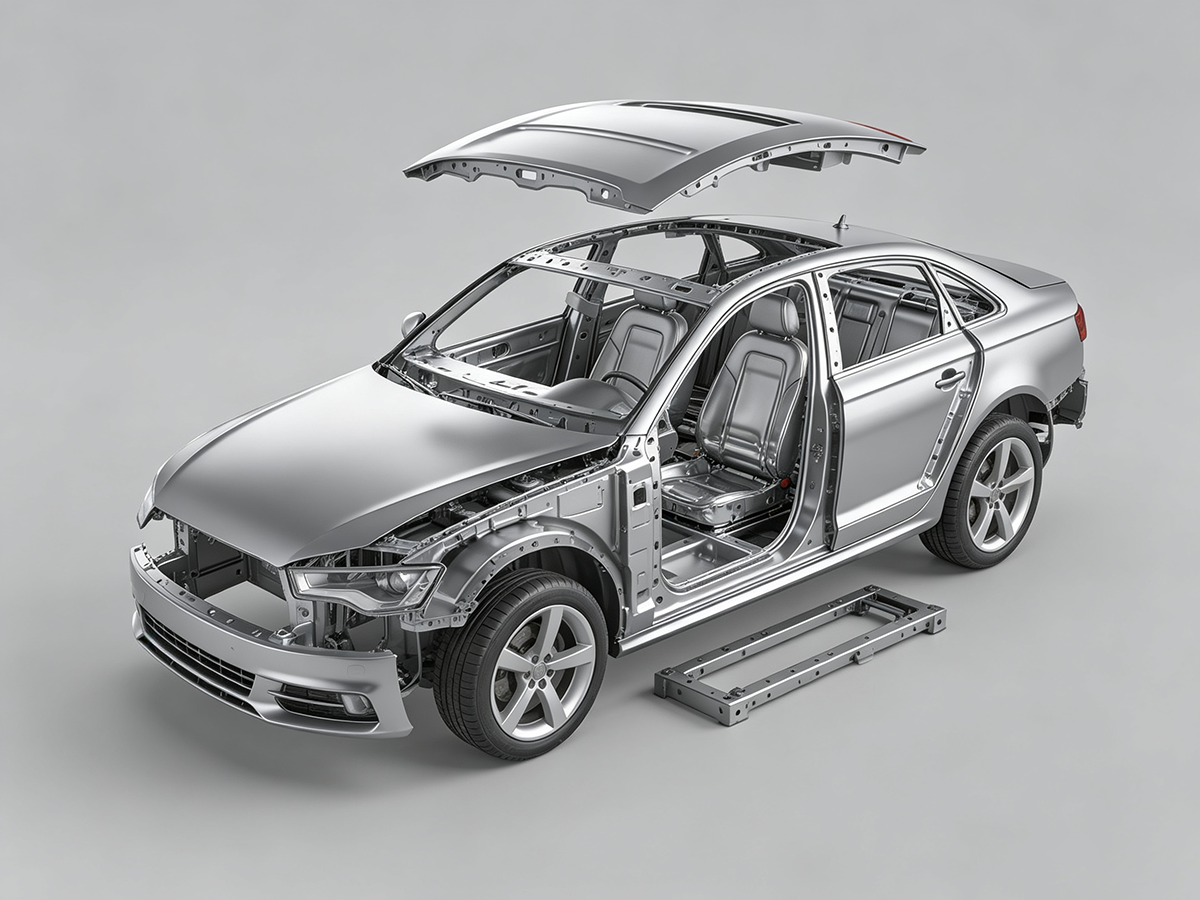
Automotive Parts That Require Stamping
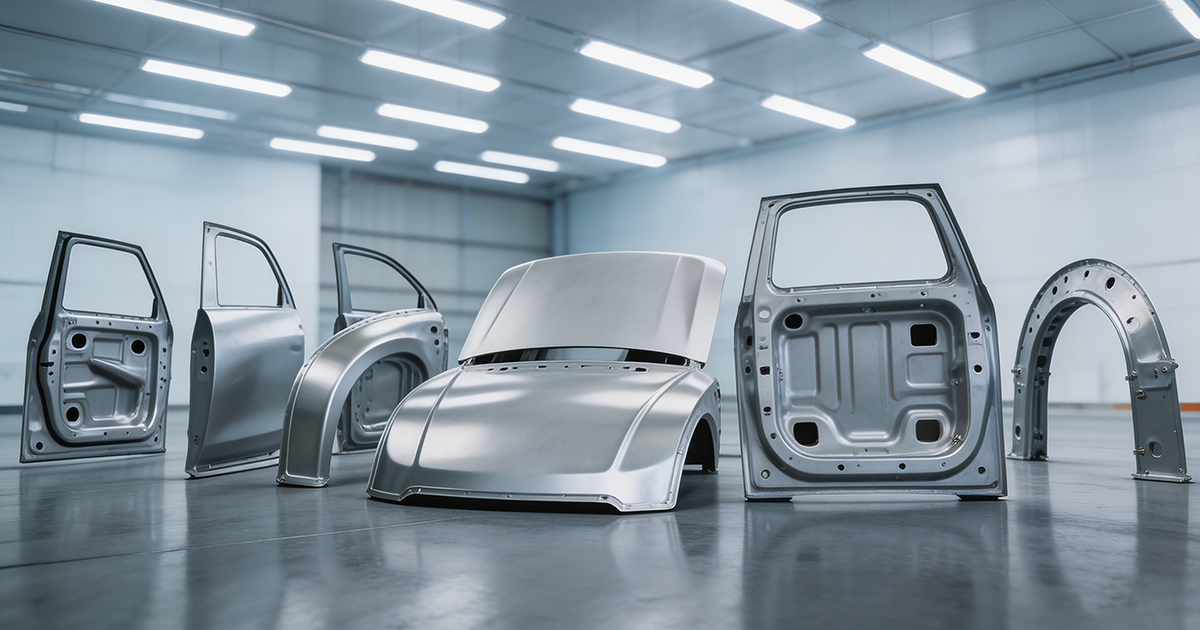
A modern vehicle contains 300–500 individual stamped parts. These fall into four major categories:
Body Panels (Class A Surfaces)
- Outer panels: Hood, doors, fenders, roof, trunk lid — require high-tonnage presses with excellent slide precision to avoid surface defects
- Inner panels: Door inners, dash panels, floor pans — deeper draws, more complex geometries
Structural Parts
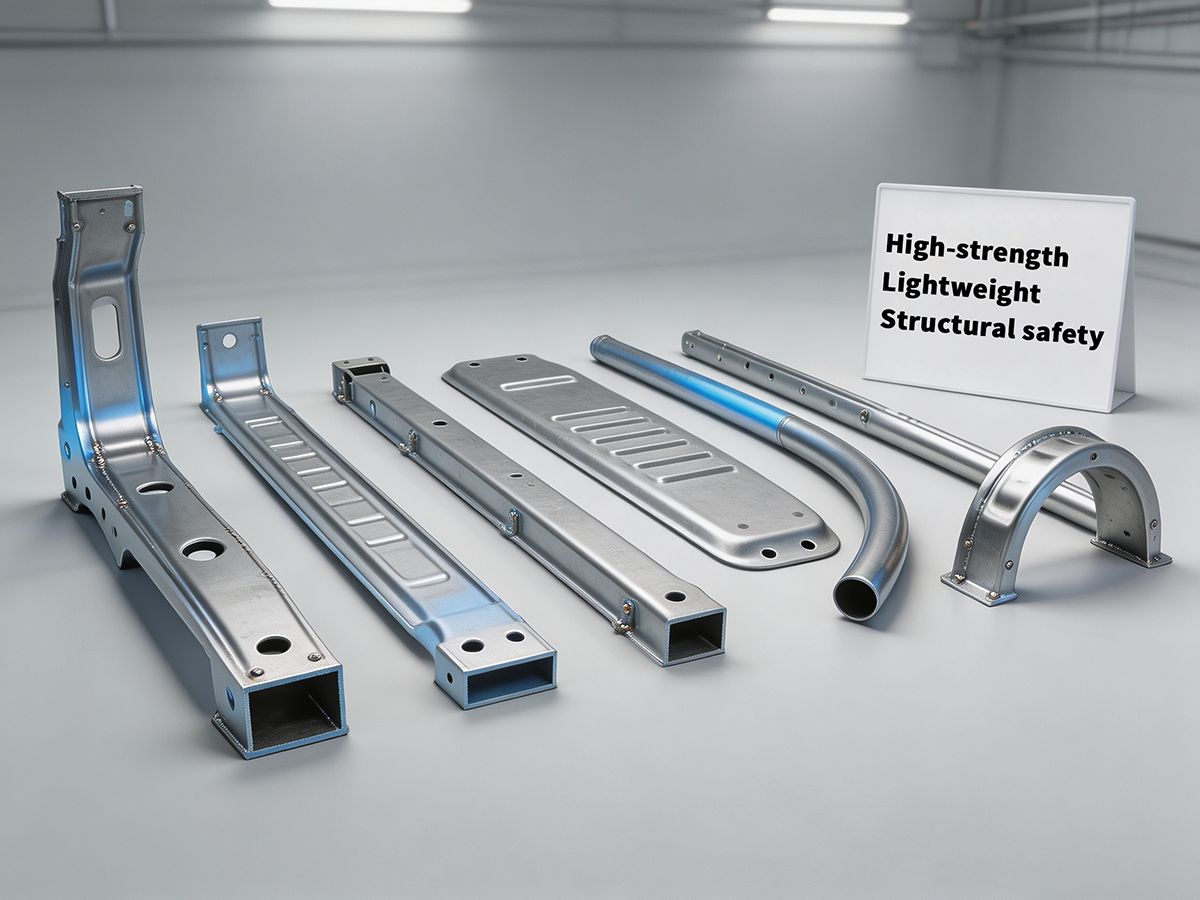
- Body reinforcements: A/B/C pillars, side members, cross members — ultra-high-strength steel (UHSS) with tonnage requirements of 800–2,500 tons
- Crash structures: Bumper beams, crash boxes — hot-stamped or press-hardened boron steel
Chassis Components
- Suspension brackets, control arm blanks, spring seats — thick material (3–8 mm), high forming forces
- Sub-frame components — large blanks requiring wide bed presses
Small Precision Parts
- Brackets, clips, retainers — high-speed progressive die stamping at 200–600 SPM
- Electrical connectors, terminal pins — micro-precision with tolerances under ±0.02 mm
Press Types for Automotive Stamping
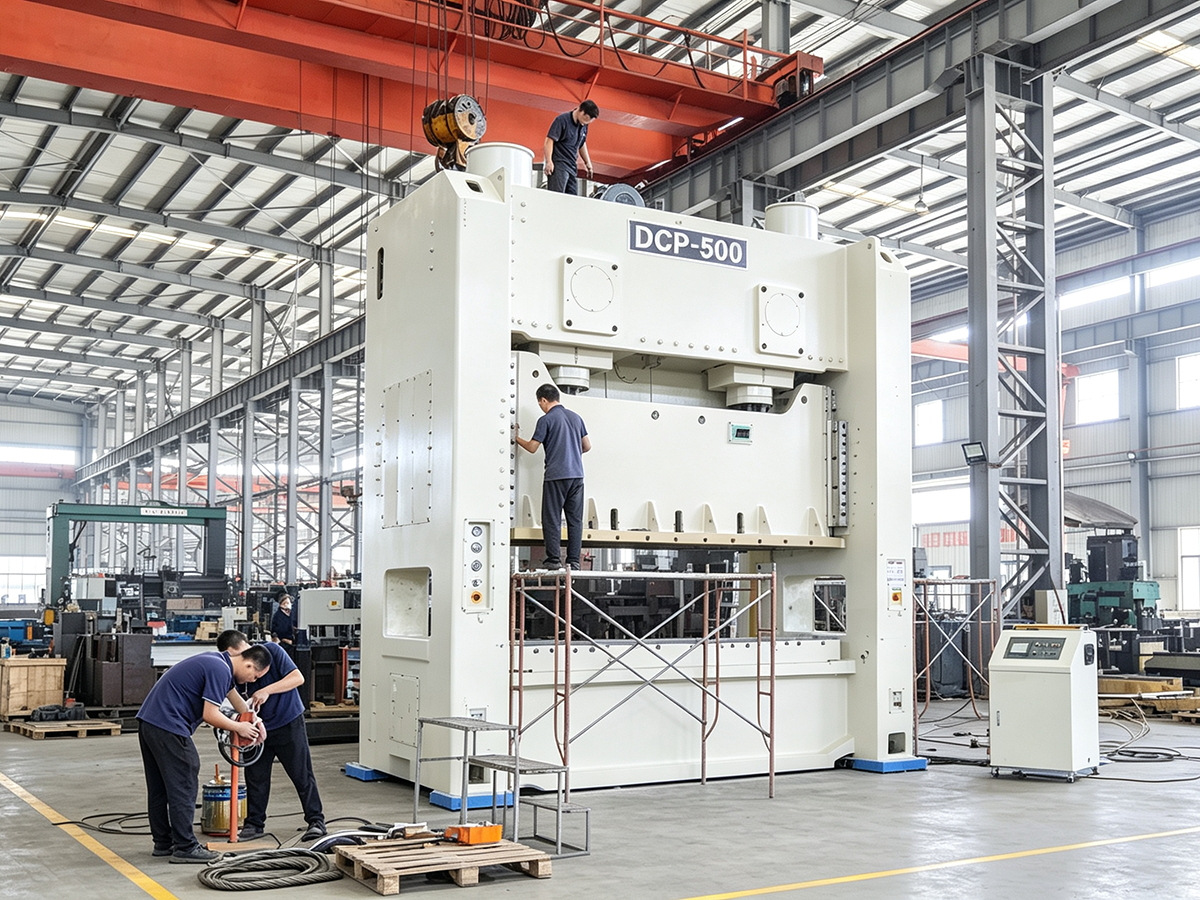
Mechanical Crank Press
The workhorse of automotive stamping. Available in C-frame (25–200 tons) and straight side (110–600+ tons) configurations. Best suited for:
- Progressive die stamping of small-to-medium parts
- Blanking, piercing, and shallow forming
- High-volume production at 30–80 SPM
When to choose: Standard automotive parts with consistent stroke requirements and moderate tonnage needs.
Servo Press
The fastest-growing segment in automotive stamping. A servo press replaces the traditional flywheel and clutch with a direct-drive servo motor, giving you full control over slide motion, speed, and position throughout the stroke.
- Programmable stroke profiles — slow approach, fast return, dwell at BDC
- 20–50% energy savings versus mechanical presses
- Ideal for deep drawing — eliminates the need for hydraulic cushions in many applications
- Tonnage range: 80–1,000+ tons for automotive applications
When to choose: Complex forming operations, UHSS parts, multi-step progressive dies, or when you need flexible stroke programming for multiple part numbers.
Hydraulic Press
Hydraulic presses provide full tonnage throughout the stroke, making them ideal for:
- Deep-drawn body panels (hoods, fenders, roofs)
- Hot stamping / press hardening of boron steel
- Prototype and low-volume production
- Sheet hydroforming (fluid cell pressing)
When to choose: Deep-draw applications requiring constant force, hot stamping lines, or flexible production with frequent die changes.
Tandem Press Lines
For high-volume body panel production, tandem press lines connect 4–6 individual presses in series, with automated transfer systems moving parts between stations. Each press performs one or two operations (draw, trim, flange, pierce).
- Production rate: 5–15 strokes per minute for large body panels
- Tonnage: Typically 800–2,500 tons per press station
- Investment: $5–$25 million+ for a complete line
When to choose: Annual production volumes above 100,000 body sets for OEM mass production.
Tonnage Requirements by Part Type
| Part Category | Material | Tonnage Range | Recommended Press |
|---|---|---|---|
| Outer body panels | Mild steel / Al | 600–2,500 tons | Servo / hydraulic |
| Inner body panels | Mild steel / HSS | 400–1,500 tons | Servo / mechanical |
| Structural (UHSS) | AHSS / DP / TRIP | 800–2,500 tons | Servo / hydraulic |
| Hot-stamped parts | Boron steel (22MnB5) | 800–2,000 tons | Hydraulic (with heated die) |
| Chassis brackets | HSLA / thick steel | 200–600 tons | Straight side mechanical |
| Small brackets & clips | Mild steel / spring steel | 45–200 tons | C-frame / high-speed |
| Electrical terminals | Copper / brass | 30–110 tons | High-speed press |
Tonnage rule of thumb: Calculate forming force using material tensile strength × blank perimeter × thickness × a safety factor of 1.2–1.5. When in doubt, size up — running a press at 90%+ of rated tonnage accelerates wear and reduces die life.
Key Specifications to Evaluate
Slide Accuracy & Parallelism
For automotive Class A surfaces, slide parallelism must be within 0.02 mm/m. JIS Special Class or equivalent precision is recommended for outer panels. Poor slide accuracy causes uneven draw, springback variation, and surface defects that show through paint.
Bed Size and Bolster
Automotive dies are large. A typical door outer die requires a bed of at least 2,500 × 1,800 mm. Full-size body panel dies can demand 4,000 × 2,200 mm or larger. Always verify the bolster thickness and T-slot configuration matches your die set.
Stroke and Speed
| Application | Stroke Length | Speed (SPM) |
|---|---|---|
| Large body panels | 600–1,000 mm | 8–18 SPM |
| Medium structural parts | 300–500 mm | 15–30 SPM |
| Small brackets (progressive) | 100–250 mm | 40–120 SPM |
| High-speed terminals | 30–80 mm | 200–600 SPM |
Cushion System
Deep-drawing automotive panels requires a blank holder force to control material flow. Options include:
- Pneumatic cushion: Standard for most body panel forming, 10–20% of press tonnage
- Hydraulic cushion: More precise control, programmable pressure profiles — preferred for UHSS and aluminum
- Servo-controlled cushion: Highest precision, zone-control capability for complex panels
Automation and Press Line Integration
Modern automotive stamping demands fully integrated press lines — not just standalone presses.
- Transfer systems: Mechanical, servo-driven, or robot-based part transfer between presses (cycle time: 3–8 seconds)
- Die change systems: Quick die change (QDC) with roller bolsters and automatic clamping — changeover in under 10 minutes
- Blank loading: Automatic destacking and blank feeding from coil or blank stack
- Quality monitoring: In-die sensors, tonnage monitoring, vision inspection at press exit
- MES integration: Real-time production data, OEE tracking, predictive maintenance alerts
A fully integrated automotive stamping line with servo presses and robotic transfer can achieve 90%+ OEE — compared to 60–70% for manual-fed mechanical press setups.
Taifeng Press Solutions for Automotive Stamping
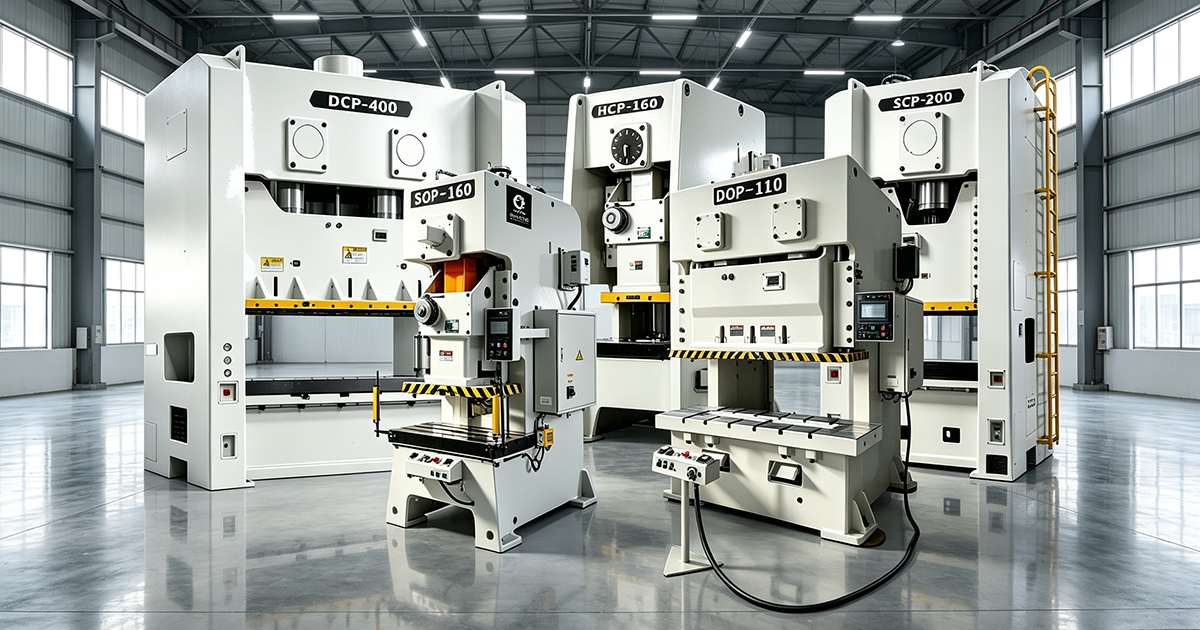
Taifeng Machinery manufactures a complete range of precision stamping presses for automotive applications, from 25-ton C-frame presses for small brackets to 600-ton straight side presses for structural components:
- SOP Series (C-Frame, 25-315T): Ideal for automotive brackets, clips, and small structural components with progressive dies
- DTP Series (Deep Throat C-Frame, 25-200T): Deep-draw capability for automotive interior brackets and panels
- DCP Series (Straight Side Double Crank, 110-600T): High-rigidity frame for large automotive structural parts, chassis components, and medium body panels
- SCP Series (Straight Side Single Crank, 200-600T): Precision straight side press for medium-tonnage automotive progressive die work
- DOP Series (C-Frame Double Crank, 110-250T): Wide-bed C-frame for larger automotive blanks requiring double-crank stability
- HCP Series (Semi-Closed Single Crank, 80–300T): Compact semi-closed frame for automotive forming operations with limited floor space
All Taifeng presses are manufactured with JIS Class 1 precision, hardened and ground gears, and integrated PLC control systems. We provide complete automotive stamping solutions including die design consultation, press + feeder integration, and on-site installation support.
Need help selecting the right press for your automotive application? Send us your part drawing and material specifications — our engineering team will recommend the optimal press configuration within 24 hours.