Introduction
When choosing between a C-frame vs straight side press, manufacturers must consider tonnage, precision, deflection, and production volume. The two dominant designs — C-frame (gap frame) and straight side (pillar frame) — serve fundamentally different production needs. Choose wrong, and you face premature die wear, poor part accuracy, or wasted capital on over-specified equipment.
This guide breaks down the structural, performance, and application differences so you can match the press to your actual requirements for high-precision and high-volume metal stamping.
What Is a C-Frame Stamping Press?
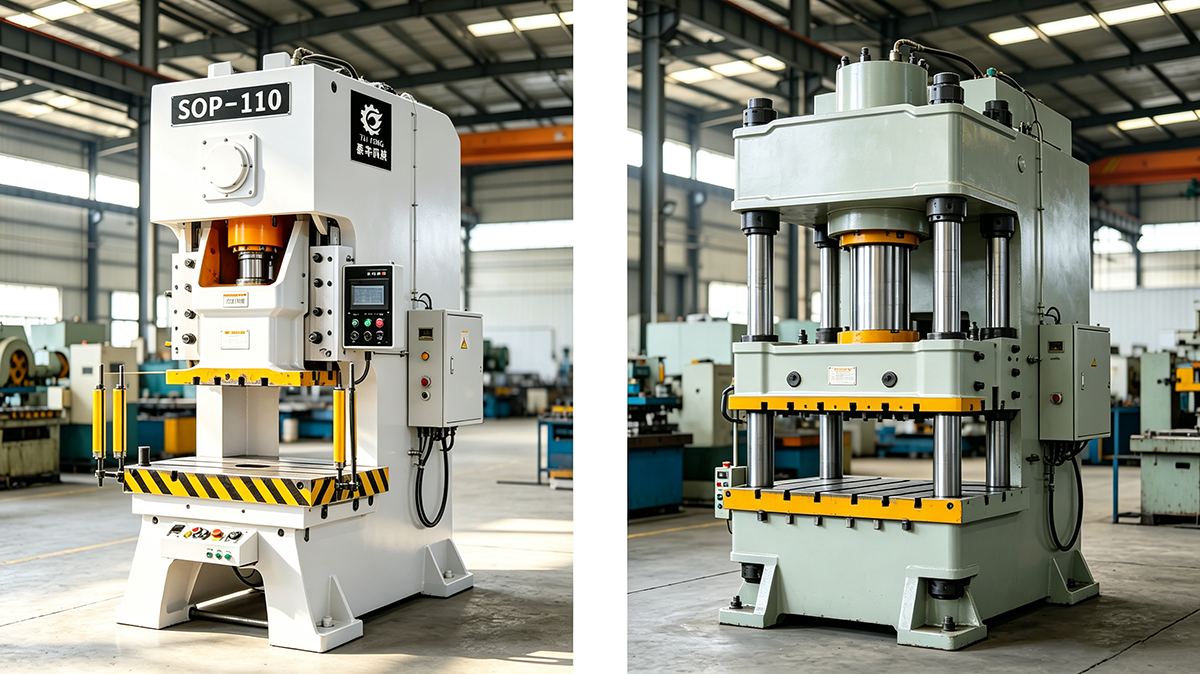
A C-frame press gets its name from the open, C-shaped frame structure. The bolster (bed) and ram are connected by a single upright column with an open gap on three sides.
Key characteristics:
- Open throat design provides easy access from the front and sides
- Compact footprint — ideal for space-constrained workshops
- Typically available from 5 tons to 250 tons
- Lower acquisition cost compared to straight side presses
- Widely used for blanking, bending, punching, and light forming
Advantages
- Accessibility: Three-sided open area allows easy die loading, part removal, and scrap handling
- Flexibility: Operators can feed material from multiple angles
- Cost-effective: 20–40% lower price point at equivalent tonnage
- Footprint: Smaller installation area, easier to relocate
Limitations
- Deflection under load: The open C-frame naturally deflects (angular distortion) under off-center loads, which affects die alignment over time
- Tonnage ceiling: Most manufacturers cap C-frame designs at 200–250 tons
- Angular accuracy: Less suitable for tight-tolerance progressive die work
What Is a Straight Side Stamping Press?
A straight side press uses a closed, pillar-type frame — two or four vertical columns connect the bed and crown (top), creating a rigid box structure.
Key characteristics:
- Closed frame distributes load evenly across four tie rods or columns
- Available from 45 tons to 3,000+ tons
- Superior rigidity — minimal angular deflection under off-center loads
- Standard in high-volume, high-precision production environments
Advantages
- Frame rigidity: Deflection is 3–5× lower than a C-frame of equivalent tonnage — critical for progressive dies and tight tolerances
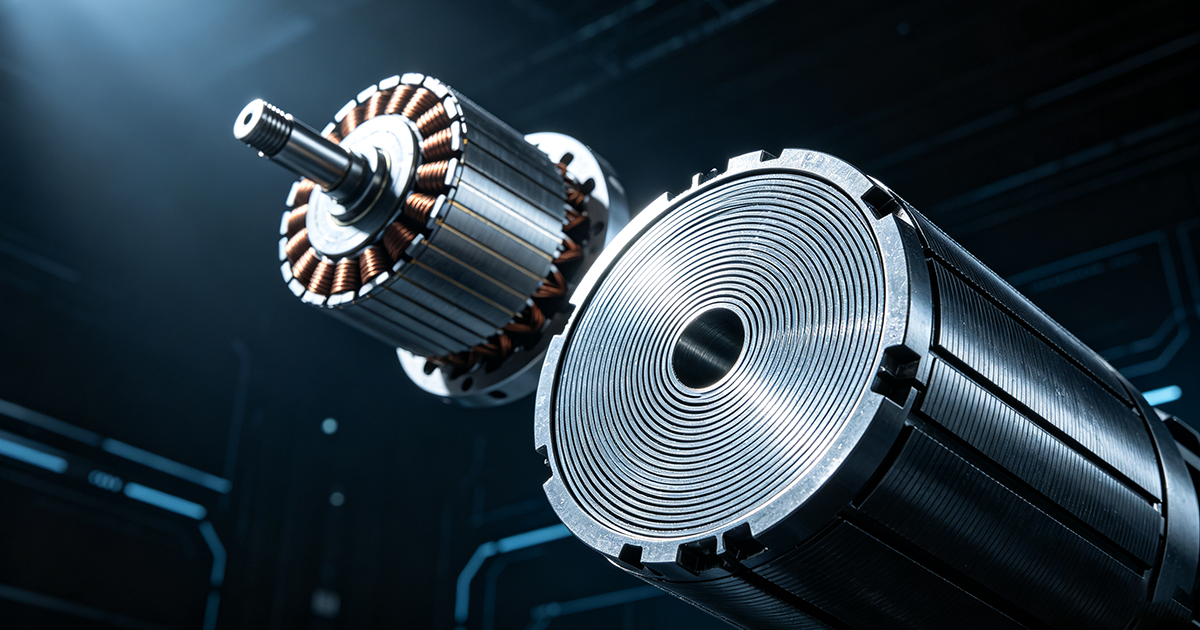
- Tonnage range: Scales from medium-duty to heavy industrial applications (automotive body panels, motor lamination)
- Die life: Consistent alignment reduces uneven die wear, extending tooling life by 30–50%
- Tie rod absorption: Four-column design absorbs shock loads and vibration, protecting both die and frame
Limitations
- Higher cost: 30–50% more expensive at equivalent tonnage
- Larger footprint: Requires more floor space and heavier foundation
- Accessibility: Closed frame limits operator access; typically requires automated feeding
Side-by-Side Comparison
The C-frame vs straight side press comparison below highlights the key differences in rigidity, speed, precision, and cost — helping you make the right decision for your stamping operation.
| Parameter | C-Frame | Straight Side |
|---|---|---|
| Frame rigidity | Moderate | High |
| Angular deflection | Higher (open frame) | Minimal (closed frame) |
| Max tonnage | ~250 tons | 3,000+ tons |
| Throat depth | Generous (open gap) | Fixed by frame width |
| Die access | Excellent (3-sided) | Limited (front/rear) |
| Typical feed system | Manual / coil feed | Coil feed / transfer |
| Progressive die suitability | Limited | Excellent |
| Price (same tonnage) | Lower | Higher |
| Foundation requirement | Light | Heavy |
| Best for | Short-run, flexible jobs | High-volume, precision |
When to Choose C-Frame
- ✅ Small to medium batch production — job shops, prototyping, short runs
- ✅ Manual or semi-automated feeding — operator needs three-sided access
- ✅ Simple operations — punching, notching, light bending, blanking
- ✅ Budget constraints — lower capital investment, lower installation cost
- ✅ Space-limited facilities — compact footprint, easier to rearrange
Typical applications: Electrical enclosure punching, small bracket stamping, sheet metal fabrication, hardware production, appliance parts
When to Choose Straight Side
- ✅ Progressive die stamping — requires consistent die alignment across millions of strokes
- ✅ High-volume production — automotive, EV motor lamination, connector stamping
- ✅ Off-center loads — asymmetric parts, multiple-station dies
- ✅ Tight tolerances — JIS Class 1 or better accuracy requirements
- ✅ Heavy tonnage needs — deep drawing, thick material forming
Typical applications: Automotive body panels, EV motor core lamination, silicon steel stamping, connector terminals, appliance chassis
The Deflection Factor: Why It Matters
In the C-frame vs straight side press debate, the most overlooked difference is frame deflection — how much the press frame distorts under load.
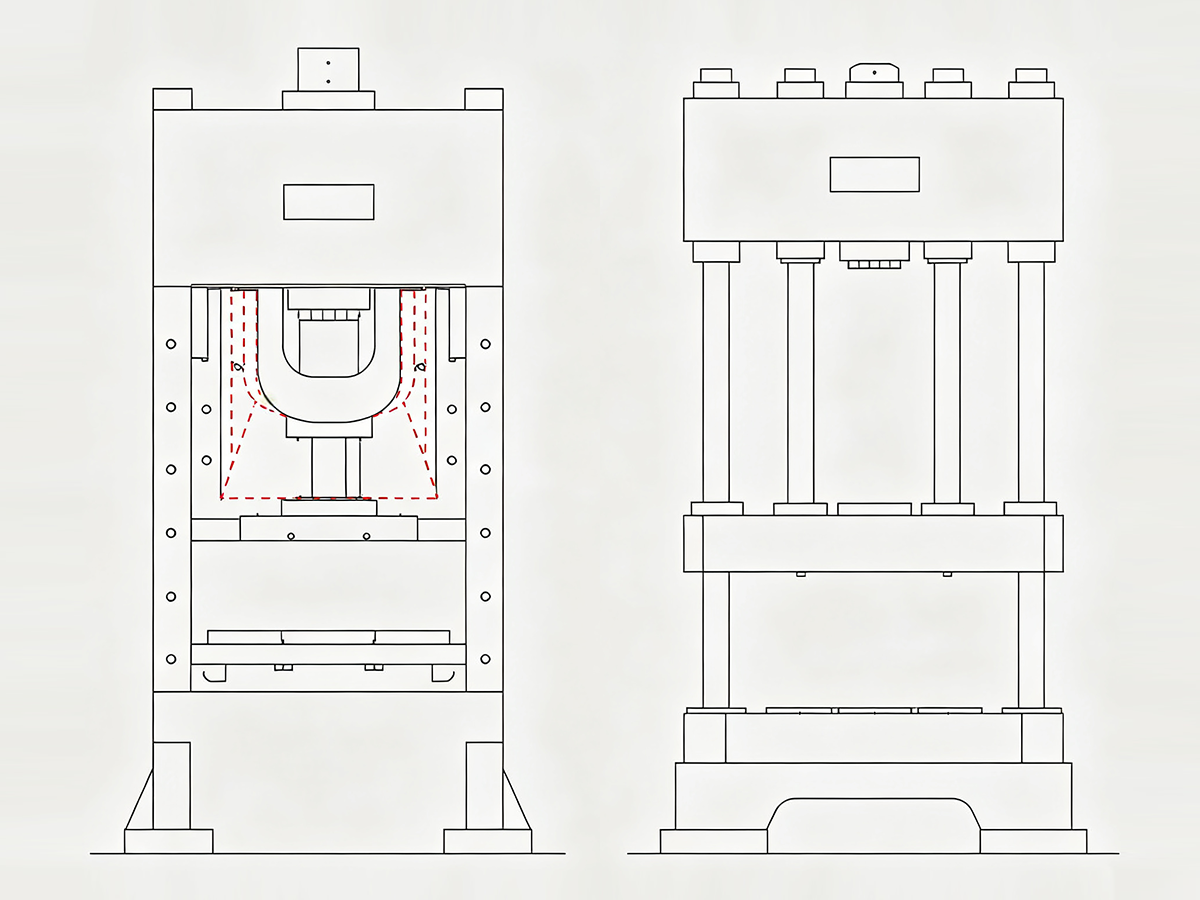
A C-frame press at 100 tons can deflect 0.15–0.25 mm/m at the open throat. A straight side press of the same tonnage deflects only 0.03–0.08 mm/m.
This matters because:
- Die clearance: Progressive dies require consistent 5–10% clearance on each side. Frame deflection shifts the punch-die alignment, causing burrs, cracking, and premature die failure.
- Part accuracy: For stamped parts with ±0.05 mm tolerance, frame rigidity is non-negotiable.
- Tooling cost: Replacing a progressive die costs 5–20× more than the press price premium for a straight side frame.
Rule of thumb: If your die cost exceeds 30% of the press cost, invest in a straight side frame. The die life savings alone will justify the premium within 12–18 months.
Decision Framework
Understanding C-frame vs straight side press differences is essential. Ask these questions to determine which frame type fits your application:
- What tonnage do you need?
- Under 100 tons → C-frame is viable
- Over 100 tons → Evaluate straight side
- Are you running progressive dies?
- Yes → Straight side (non-negotiable for high-volume progressive work)
- No → C-frame is acceptable
- What tolerance does your part require?
- ±0.1 mm or tighter → Straight side recommended
- ±0.2 mm or looser → C-frame is sufficient
- What is your production volume?
- Under 50,000 parts/month → C-frame
- Over 100,000 parts/month → Straight side
- Do you plan to automate?
- Coil feed line / transfer system → Straight side (designed for automated integration)
- Manual or semi-auto → C-frame
About Taifeng Machinery
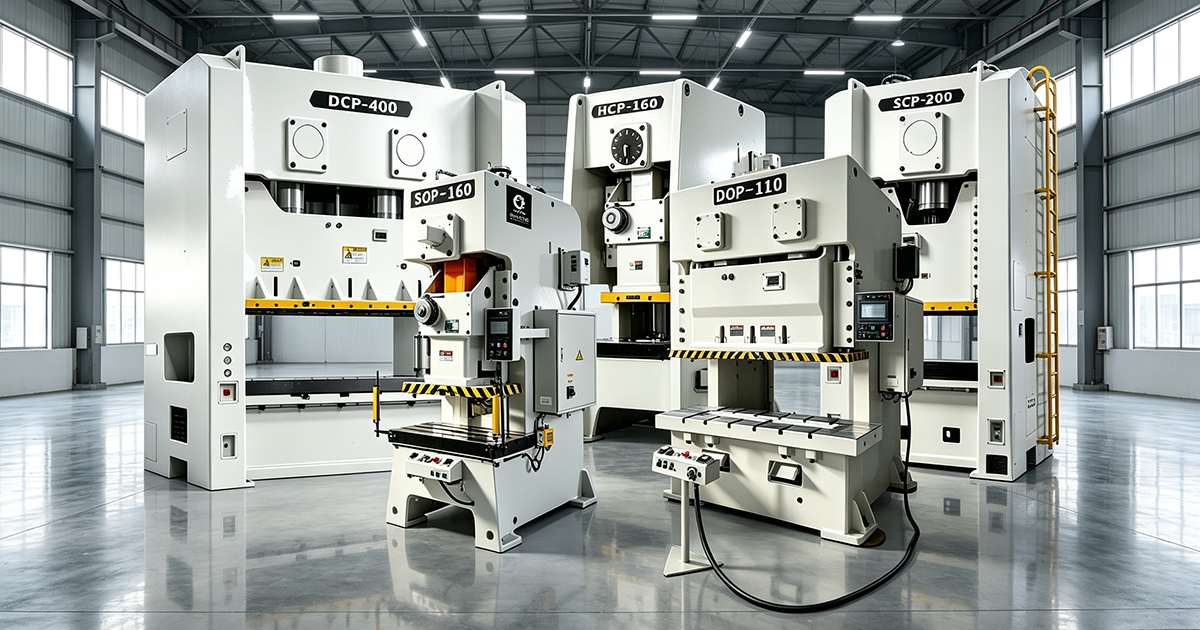
Taifeng Machinery manufactures both C-frame and straight side stamping presses from 25 tons to 600 tons. Our presses are used by manufacturers in automotive, electronics, appliance, and EV motor core stamping across Vietnam, India, Mexico, Turkey, and 30+ countries.
Need help selecting the right press frame for your application?
- 📞 WhatsApp: +86 158 1350 2570
- 📧 Email: mxianglife@gmail.com
- 🌐 Visit: taifengpress.com